
The 2026 “Need-to-Act” Matrix for HR Priorities: A Strategic Guide for CHROs
The evolving world of work is forcing HR leaders to move beyond traditional practices and step into a more strategic, technology-driven role. The 2026 “Need-to-Act” Matrix for HR Priorities offers a clear roadmap for Chief Human Resource Officers (CHROs) to identify where effort, investment, and transformation are most urgently required.
This blog breaks down the matrix into actionable insights, helping organizations align HR strategy with future business demands.
Understanding the “Need-to-Act” Matrix
The matrix maps HR priorities across two critical dimensions:
- Future Importance (How critical the capability will be)
- Current Capability (How strong organizations are today)
This creates three zones:
- Strong Need to Act (High importance, low capability)
- Medium Need to Act
- Low Need to Act
The key takeaway:
👉 The biggest competitive advantage lies in closing high-impact capability gaps—not just maintaining current strengths.
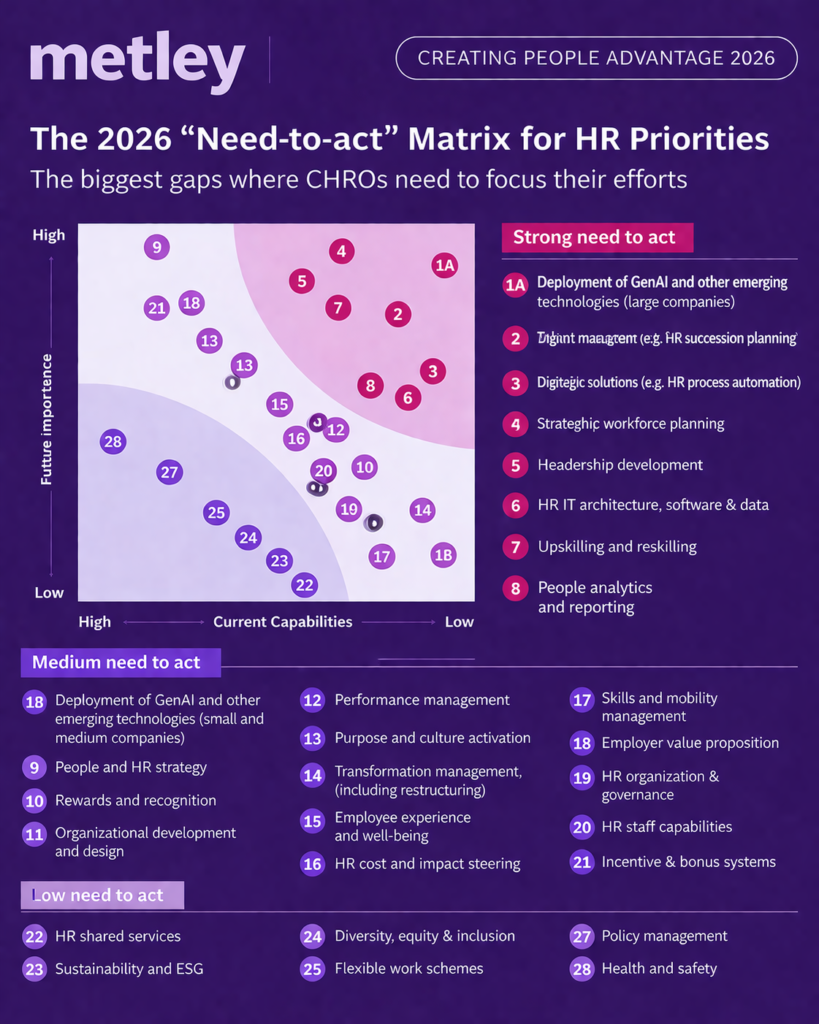
Strong Need to Act: Critical HR Priorities for 2026
These are the areas where most organizations are underprepared but must act immediately.
1. Deployment of GenAI and Emerging Technologies
AI is no longer optional—it’s foundational. From recruitment automation to predictive workforce planning, GenAI is redefining HR.
Strategic Action:
- Invest in AI-powered HR platforms
- Build AI literacy across HR teams
- Redesign processes around automation
2. Talent Management & Succession Planning
Organizations are struggling to build robust talent pipelines, especially for leadership roles.
Strategic Action:
- Implement data-driven succession models
- Identify high-potential employees early
- Create internal talent marketplaces
3. Digital HR Solutions
Manual HR processes are a major bottleneck.
Strategic Action:
- Automate core HR processes (payroll, onboarding, performance tracking)
- Integrate HRMS with analytics dashboards
- Enhance employee self-service platforms
4. Strategic Workforce Planning
Workforce planning is shifting from reactive to predictive.
Strategic Action:
- Use scenario-based workforce modeling
- Align workforce strategy with business growth plans
- Integrate skill forecasting tools
5. Leadership Development
Leadership capability is not keeping pace with organizational complexity.
Strategic Action:
- Build agile, adaptive leaders
- Focus on digital and emotional intelligence
- Create continuous leadership pipelines
6. HR IT Architecture, Software & Data
Fragmented HR systems limit decision-making.
Strategic Action:
- Move toward unified HR tech ecosystems
- Invest in cloud-based HR platforms
- Ensure data governance and integration
7. Upskilling and Reskilling
The skills gap is widening rapidly due to automation and digital transformation.
Strategic Action:
- Develop continuous learning ecosystems
- Partner with edtech platforms
- Focus on future skills (AI, analytics, digital)
8. People Analytics and Reporting
HR must become a data-driven function.
Strategic Action:
- Build advanced analytics capabilities
- Use predictive analytics for attrition and performance
- Train HR teams in data interpretation
Medium Need to Act: Strengthening the Core
These areas are important but relatively more mature.
Key Focus Areas:
- HR Strategy Alignment
- Rewards & Recognition
- Organizational Design
- Employee Experience & Well-being
- Transformation Management
- Skills & Mobility Management
- Employer Branding
- HR Governance
- Incentive Systems
Strategic Insight:
These are optimization levers, not transformation drivers. Organizations should refine and integrate them with high-priority areas.
Low Need to Act: Maintain, Not Overinvest
These are areas where organizations are relatively well-equipped.
Includes:
- HR Shared Services
- Sustainability & ESG
- Diversity, Equity & Inclusion
- Flexible Work Models
- Policy Management
- Health & Safety
Strategic Insight:
While important, these areas should be maintained efficiently rather than aggressively expanded—unless driven by regulatory or industry-specific needs.
Key Insights for HR Leaders
1. The Shift from Administrative to Strategic HR
HR is no longer a support function—it is a core driver of business transformation.
2. Technology + Talent = Competitive Advantage
Organizations that integrate AI with human capability will outperform others.
3. Capability Gaps Are the Real Risk
The biggest threat is not external competition—but internal unpreparedness.
4. Data is the New HR Currency
Decisions must shift from intuition to analytics-driven insights.
A Strategic Roadmap for Implementation
To operationalize the matrix, CHROs should adopt a phased approach:
Phase 1: Diagnose
- Conduct capability gap analysis
- Benchmark against industry standards
Phase 2: Prioritize
- Focus on “Strong Need to Act” areas
- Align initiatives with business goals
Phase 3: Build
- Invest in technology and skills
- Redesign HR processes
Phase 4: Integrate
- Connect HR systems, data, and workflows
- Enable cross-functional collaboration
Phase 5: Measure
- Define KPIs (e.g., skill readiness, leadership pipeline strength)
- Track ROI of HR initiatives
Final Thoughts
The 2026 Need-to-Act Matrix is more than a diagnostic tool—it is a strategic blueprint for HR transformation.
Organizations that act decisively on high-priority gaps will:
- Build future-ready workforces
- Enhance organizational agility
- Gain a sustainable competitive edge
Those that delay risk falling behind in an increasingly digital, skills-driven economy.